New
Pre-Order
We'll notify you once when this item is available. No spam.
You qualify for FREE shipping!
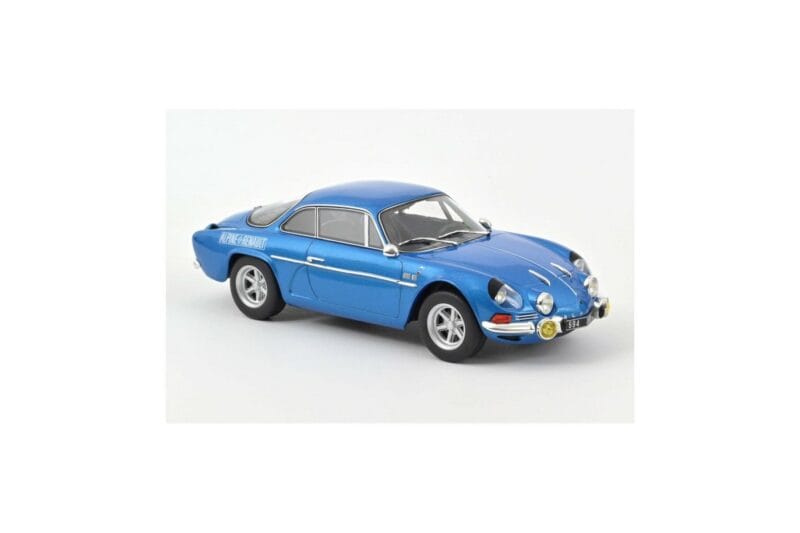
Norev's 1:18 Alpine A110 1600S preserves the 1972 French rally weapon that rewrote competition rules through systematic weight reduction and rear-engine traction advantage. Jean Rédélé's Berlinette dominated European rallying when manufacturers still prioritized innovation over homologation politics, winning the inaugural World Rally Championship in 1973 with drivers who understood that 1,100 pounds matters more than 200 horsepower on mountain passes. This Alpine A110 1:18 scale model demonstrates why French collectors choose Norev for French automotive subjects—the manufacturer that documented Renault, Citroën, and Alpine evolution across seven decades understands these vehicles at cultural depth that international alternatives cannot match.
The Alpine A110 1600S earned its rally reputation through engineering philosophy that predicted modern performance car development by four decades: build light, maximize chassis balance, let physics handle the rest. Between 1970 and 1973, A110s won the Monte Carlo Rally three times, captured the Tour de France Automobile five consecutive years, and claimed the 1973 World Rally Championship manufacturer's title outright. Jean-Pierre Nicolas, Bernard Darniche, and Jean-Luc Thérier drove A110s to victories across tarmac, gravel, and snow, demonstrating versatility that heavier British and Italian competitors couldn't match.
Norev's 1972 specification captures the 1600S at its competition peak—the Gordini-tuned engine producing 138 horsepower, fiberglass body panels eliminating rust concerns that plagued steel alternatives, and rear weight bias providing traction advantages on surfaces where front-heavy rivals struggled. The proportions reveal why the A110 worked: short wheelbase for agility, engine behind the rear axle for natural oversteer control, minimal overhangs reducing moment of inertia. This wasn't exotic engineering requiring factory support—privateers campaigned A110s successfully because the fundamental concept rewarded driver skill over budget.
Norev chose diecast for the Alpine A110 1600S because French automotive heritage collecting prioritizes comprehensive coverage over ultra-limited premium pieces. Where resin manufacturers produce individual highlights, Norev's production approach enables collectors to document complete French automotive lineages—Alpine's evolution from A106 through A310, Renault's sports car development, Citroën's design innovation—at pricing that supports breadth rather than forcing choices between individual models.
This 1:18 Alpine A110 model features opening doors and rear engine cover revealing the Gordini powerplant detail, along with period-correct blue paint that French collectors associate with Alpine competition livery. At roughly 22 centimeters, the A110's compact dimensions make 1:18 scale particularly effective—enough size to appreciate the Berlinette's distinctive rear haunches and front-hinged hood without the space demands that make 1:18 impractical for larger vehicles. Norev's manufacturing costs roughly one-third premium resin alternatives from Ottomobile or Solido Prestige, positioning this replica where French automotive enthusiasts can build comprehensive Alpine collections including the A108, A110, A310, and modern A110 revival without specialist budgets per piece.
The Alpine A110's rear-engine layout connects it to automotive philosophy that Porsche pursued with the 911, Renault explored with the R8 Gordini, and Fiat attempted with the 850 Coupe—but Alpine executed most successfully for competition application. The engine-behind-axle configuration that makes road cars tricky in untrained hands becomes an advantage when drivers understand weight transfer dynamics and throttle-steering techniques. Rally drivers valued the A110 for precisely this characteristic: predictable oversteer that could rotate the car through tight switchbacks without losing momentum.
Norev's replica captures the visual signatures that distinguish the 1600S from earlier variants—the revised front bumper configuration, period-correct Gordini striping options, and the characteristic stance that results from rear weight bias. The A110's fiberglass body construction, radical for 1960s production cars, eliminated the rust concerns that destroyed most contemporary European sports cars within a decade of manufacture. Survivors command increasing value as collectors recognize that lightweight sports cars built for pure driving engagement—not luxury appointment or straight-line acceleration—represent philosophical purity that modern performance cars rarely achieve.
<nFor collectors documenting 1970s rally evolution, the Alpine A110 anchors French competition heritage alongside the Lancia Stratos, Ford Escort RS, and Porsche 911 Carrera RS as vehicles that defined the era before Group B raised stakes to unsustainable levels. The A110 proved rally success required neither exotic displacement nor complex four-wheel-drive systems—just intelligent engineering execution and driver talent. This Norev 1:18 diecast positions appropriately for such thematic displays: production-level quality that enables comprehensive grid-building without premium resin investment per model.
Collectors pursuing French automotive heritage often structure displays chronologically—Bugatti Type 35 establishing French racing pedigree, Citroën DS demonstrating design innovation, Alpine A110 capturing competition dominance, Renault 5 Turbo representing hot hatch evolution. At 1:18 scale with accessible pricing, the Norev Alpine A110 supports this breadth-focused approach rather than forcing choices between individual highlight pieces. The A110's significance extends beyond competition results to cultural impact: Jean Rédélé's decision to build lightweight sports cars in Dieppe, France, when conventional wisdom demanded Italian or British heritage for such vehicles, demonstrated that engineering philosophy mattered more than manufacturing location. The A110 won on merit, not reputation.