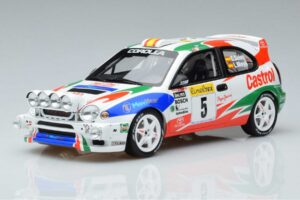
Classic WRC Models - Golden Era Rally Championship Heritage
More about our models
Classic WRC replicas preserve the sport's golden era from Group A regulations through early World Rally Car development, spanning Lancia Delta Integrale dominance to the legendary Subaru versus Mitsubishi rivalry that defined 1990s competition. IXO, Trofeu, and Minichamps document this championship heritage across 1:18 and 1:43 scales for rally collectors.
- Shipping to:
- United States (US)
- Currency:
- USD
- Prices include
- VAT
- Free shipping:
- from 79€
Secure Checkout
14-Day Returns
4.8/5 rating
Secure Checkout
Free shipping from 79€
14-Day Returns
Recently Viewed Models
Collecting WRC Classic Model Cars
Browse 1 WRC Classic scale models — diecast and resin from leading manufacturers
What WRC Classic model cars do you offer?
Our WRC Classic collection features 1 diecast and resin scale models across all major scales and price ranges. Featured brands: Toyota. New arrivals added regularly.
Which manufacturers make WRC Classic models?
WRC Classic models are produced by Otto, among others. Each manufacturer brings different strengths — from budget-friendly diecast to hand-finished resin limited editions.
What scales are available for WRC Classic model cars?
WRC Classic models are available in 1:18. The 1:18 scale (25-28 cm) offers the most detail; 1:43 is compact and ideal for larger collections.
Are WRC Classic diecast models collectible?
WRC Classic models are among the most sought-after in the hobby. Limited resin editions (under 3,000 pieces) appreciate after selling out. Key factors: production run size, manufacturer reputation, and the car's status among enthusiasts.
How to choose the best WRC Classic model car?
For WRC Classic models, choose your scale first — 1:18 for display impact, 1:43 for variety. Then compare materials: diecast for hands-on handling, resin for sharper detail. Solido and Norev for value, AUTOart for premium with opening parts.
Are WRC Classic model cars good gifts for car enthusiasts?
WRC Classic diecast models make memorable gifts for car enthusiasts. Choose 1:18 scale for maximum visual impact on the shelf. Look for models with opening parts for interactive display. Norev and Solido offer gift-ready quality in branded manufacturer packaging.
How are model cars shipped?
5-layer packing: original box, bubble wrap, foam inserts, reinforced carton, FRAGILE markings. All shipments tracked and insured. Damage rate under 0.1%.
Do you offer returns?
14-day returns on unused items in original packaging. Defective or damaged in transit? Free replacement — contact us with photos within 48 hours.
Classic WRC models capture rally's most celebrated competition era, documenting the machinery and driver rivalries that transformed the World Rally Championship into a global motorsport phenomenon from 1987 through 2010. This period spans from Group A homologation specials that connected rally competition directly to showroom accessibility, through the introduction of World Rally Car regulations in 1997, to the final season before hybrid technology fundamentally altered championship dynamics. For collectors, classic WRC represents the golden age when Colin McRae's spectacular driving style, Tommi Makinen's precision consistency, and Carlos Sainz's calculating intelligence created the driver personalities that rally fans still celebrate today, while manufacturer battles between Lancia, Toyota, Subaru, Mitsubishi, Peugeot, Citroen, and Ford delivered the most competitive championship seasons in rally history.Defining the Classic WRC Era Through Regulation Evolution
The classic WRC period begins with Group A regulations introduced for 1987 after Group B's cancellation, requiring manufacturers to produce at least 2,500 homologation examples of their competition base models. This regulation shift fundamentally changed rally from unlimited engineering experimentation to modified production car competition, creating the homologation special phenomenon where manufacturers built road-going versions specifically to qualify their rally programs. The Lancia Delta Integrale dominated this early Group A era with six consecutive manufacturers championships from 1987 through 1992, establishing four-wheel-drive turbo hatchbacks as the winning formula that competitors would follow throughout the decade.
Toyota's Celica GT-Four brought Japanese manufacturer competition to WRC prominence in the early 1990s, challenging Lancia's dominance before Carlos Sainz secured back-to-back drivers titles in 1990-1991. This set the stage for the most iconic rivalry in rally history when Subaru introduced their Impreza 555 in vivid blue livery for 1993, directly confronting Mitsubishi's Lancer Evolution in championship red. The Subaru-Mitsubishi battles through the mid-to-late 1990s captured global television audiences as Colin McRae's aggressive sideways style contrasted with Tommi Makinen's smooth precision, creating the driver personalities that defined an era.
The 1997 introduction of World Rally Car regulations relaxed homologation requirements while maintaining the production car silhouette connection, allowing manufacturers to develop purpose-built rally machines beneath recognizable body shapes. Peugeot's 206 WRC and Citroen's Xsara WRC brought French manufacturers back to championship contention, with Sebastien Loeb beginning his unprecedented nine-consecutive-championship run for Citroen in 2004. Ford's Focus RS WRC carried the Blue Oval banner through this period, while Subaru and Mitsubishi continued their rivalry into the 2000s. This classic WRC era concludes with the 2010 season, the final year before new technical regulations introducing anti-lag restrictions and aerodynamic limitations marked the transition to modern WRC competition formats.Manufacturer Coverage for Classic WRC Collectors
Classic WRC model production concentrates heavily at IXO and their dedicated RAM brand, which have systematically documented championship seasons from the late 1980s through 2010 with extensive event-by-event coverage. IXO delivers sealed 1:43 scale replicas capturing complete rally fields for major championship rounds, with accurate livery reproduction including sponsor logos, competition numbers, and driver name decals applied through tampo printing processes. This comprehensive seasonal coverage enables collectors to build complete starting grids for historically significant rallies like Monte Carlo, Finland, or Great Britain at accessible price points that make systematic documentation financially practical.
Trofeu specializes in classic rally models with particular strength in 1980s Group A machinery, producing detailed replicas of Lancia Delta Integrale variants, Toyota Celica GT-Four configurations, and other Group A homologation specials in 1:43 scale. Their focus on pre-WRC regulation machines fills coverage gaps that more modern-focused manufacturers leave unaddressed, serving collectors specifically interested in the Group A transition period that established rally's golden era foundation.
Minichamps offers premium classic WRC replicas in both 1:43 sealed format and 1:18 opening-feature diecast, concentrating on championship-winning configurations and historically significant event appearances rather than comprehensive season documentation. Their Subaru Impreza coverage includes multiple Colin McRae liveries from different championship seasons, while Mitsubishi Lancer Evolution replicas document Tommi Makinen's four consecutive title-winning campaigns. Quality levels sit between IXO's production efficiency and premium specialist tiers, offering improved paint depth and tampo print resolution at moderate price points.
Spark produces selected classic WRC highlights in sealed resin format, focusing on particularly significant championship moments or visually striking liveries from the 1990s and 2000s. Their attention to complex sponsor graphics and paint finish quality serves collectors seeking premium examples of personally meaningful rally moments. AUTOart delivers definitive 1:18 scale classic WRC models with opening features and detailed mechanical reproduction for limited selections of Group A and early WRC-regulation machines, representing the premium tier where individual hero pieces receive showcase treatment. This manufacturer diversity allows classic WRC collectors to approach the era from multiple angles simultaneously, building comprehensive seasonal documentation through IXO while adding premium focal points through Spark and AUTOart selections.Iconic Machines and Driver Legends of Classic WRC
The Lancia Delta Integrale stands as the definitive Group A rally machine, with its turbocharged four-cylinder engine, permanent four-wheel-drive system, and compact hatchback proportions establishing the template that competitors would follow throughout the 1990s. Juha Kankkunen, Miki Biasion, and Didier Auriol drove Delta Integrales to championship glory, while the road-going Integrale 16v and Evoluzione variants became the most sought-after homologation specials among enthusiast collectors. Model replicas capturing Delta Integrale variants in different liveries from successful championship seasons represent essential acquisitions for any comprehensive classic WRC collection.
The Subaru Impreza 555 in its signature blue and yellow 555 sponsorship livery became rally's most recognizable image during the mid-1990s, with Colin McRae's 1995 drivers championship breaking the established order and introducing a new generation to rally competition. His spectacular driving style, frequently sideways and occasionally destructive, contrasted sharply with the calculating precision that brought championships to competitors. Richard Burns later secured Subaru's second drivers title in 2001, demonstrating different driving philosophies could succeed in identical machinery. Impreza replicas span multiple generations from the original GC8 chassis through GD and GR iterations, with McRae and Burns liveries commanding particular collector interest.
Mitsubishi's Lancer Evolution matched Subaru's technical approach with turbocharged all-wheel-drive performance wrapped in distinctive red and white Marlboro sponsorship during the rivalry's peak years. Tommi Makinen's four consecutive drivers championships from 1996 through 1999 demonstrated consistent excellence, with his smooth driving style maximizing mechanical reliability across grueling championship seasons. The Lancer Evolution's road car variants became cult favorites among performance enthusiasts, creating additional collector crossover appeal. Carlos Sainz and Gilles Panizzi later drove Lancer Evolutions to championship contention, extending Mitsubishi's WRC relevance into the 2000s.
Peugeot's 206 WRC and Citroen's Xsara WRC dominated the early 2000s, with Marcus Gronholm securing two championships for Peugeot before Sebastien Loeb began his unprecedented run of nine consecutive titles for Citroen from 2004 through 2012. Loeb's statistical dominance redefined rally championship expectations, with his Xsara WRC and later C4 WRC replicas documenting this historic achievement. Ford's Focus RS WRC carried significant collector appeal through its connection to the road-going Focus RS variants, with McRae and Markko Martin among the drivers campaigning Focus machinery during its WRC tenure. These manufacturers created the classic WRC landscape where collector interest follows both individual driver loyalty and manufacturer heritage preferences, enabling multiple thematic collecting approaches within the same championship era.Building a Classic WRC Collection
Classic WRC collecting naturally organizes around several strategic approaches reflecting how collectors connect with this golden era heritage. Manufacturer-focused collections concentrate on single marque championship history, documenting Subaru's complete Impreza evolution from original 555 livery through later Pirelli and Rockstar sponsorship variants, or tracking Mitsubishi's Lancer Evolution development across multiple championship campaigns. This approach creates visual consistency in display arrangements while telling a comprehensive manufacturer story through competition liveries.
Driver-focused strategies follow individual rally legends across team changes and machinery evolution, collecting every available Colin McRae replica regardless of whether he drove Subaru, Ford, or Citroen machinery. Tommi Makinen collections document his Mitsubishi championship dominance alongside later Subaru appearances. Carlos Sainz collectors need Toyota, Subaru, Ford, and Citroen replicas to capture his complete career spanning multiple manufacturer partnerships. This collecting approach prioritizes driver loyalty over visual consistency, creating displays that document individual careers rather than team histories.
Era-specific approaches concentrate on particular championship periods, such as complete 1995 season collections documenting that year's dramatic championship battle, or comprehensive 1998-1999 coverage capturing peak Subaru-Mitsubishi rivalry. Event-focused collectors build complete starting grids for historically significant rally editions, assembling every competitor from memorable Monte Carlo or Rally Finland running where dramatic weather conditions or championship implications created legendary competition moments.
Scale strategy for classic WRC collecting typically centers on 1:43 format as the practical choice for comprehensive championship documentation, enabling collectors to display complete rally fields from multiple seasons within reasonable shelf space while maintaining sufficient detail for livery recognition and sponsor identification. The 1:18 format serves hero-piece treatment for personally significant championship moments or favorite driver liveries, with opening features and increased detail justifying the larger scale for select acquisitions. Many experienced classic WRC collectors maintain this dual-scale approach, using 1:43 for systematic season coverage and 1:18 for landmark machines that defined the golden era, creating display arrangements that balance breadth documentation with focal-point emphasis on the rally legends that made this period unforgettable.