{"ajaxurl":"https:\/\/models118.da.smarthost.pl\/wp-admin\/admin-ajax.php","nonce":"1ac71b5fbc","homeUrl":"https:\/\/models118.da.smarthost.pl\/","shopUrl":"https:\/\/models118.da.smarthost.pl\/shop\/","collectionLimit":12,"i18n":{"addedToCart":"Added to cart","addedToWishlist":"Added to wishlist","removedFromWishlist":"Removed from wishlist","error":"Something went wrong","loading":"Loading...","outOfStock":"Out of stock","viewCart":"View cart","addedToCollection":"Added to Collection","reserved":"Reserved!","invalidEmail":"Please enter a valid email address","connectionError":"Connection error. Please try again."},"stats":{"models":552,"brands":31,"makers":11,"collectors":10000}}
Modern WRC Models - Contemporary Rally Championship Heritage
More about our models
Modern WRC replicas document the championship's evolution from 2011 forward, spanning the introduction of 1.6-liter turbocharged World Rally Cars through current Rally1 hybrid regulations. IXO and Spark capture Toyota GR Yaris, Hyundai i20 N, and Ford Puma machinery across 1:18 and 1:43 scales for contemporary rally collectors.
Browse 3 WRC Modern scale models — diecast and resin from leading manufacturers
What WRC Modern model cars do you offer?
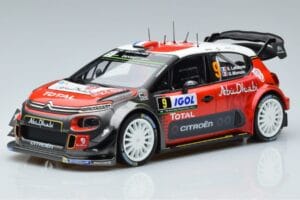
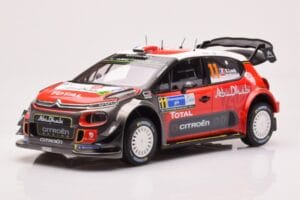
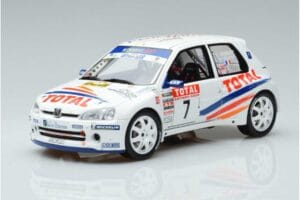
Our WRC Modern collection features 3 diecast and resin scale models across all major scales and price ranges. Featured brands: Citroen, Peugeot. New arrivals added regularly.
Which manufacturers make WRC Modern models?
WRC Modern models are produced by Norev, Otto, among others. Each manufacturer brings different strengths — from budget-friendly diecast to hand-finished resin limited editions.
What scales are available for WRC Modern model cars?
WRC Modern models are available in 1:18. The 1:18 scale (25-28 cm) offers the most detail; 1:43 is compact and ideal for larger collections.
Are WRC Modern diecast models collectible?
WRC Modern models are among the most sought-after in the hobby. Limited resin editions (under 3,000 pieces) appreciate after selling out. Key factors: production run size, manufacturer reputation, and the car's status among enthusiasts.
How to choose the best WRC Modern model car?
For WRC Modern models, choose your scale first — 1:18 for display impact, 1:43 for variety. Then compare materials: diecast for hands-on handling, resin for sharper detail. Solido and Norev for value, AUTOart for premium with opening parts.
Are WRC Modern model cars good gifts for car enthusiasts?
WRC Modern diecast models make memorable gifts for car enthusiasts. Choose 1:18 scale for maximum visual impact on the shelf. Look for models with opening parts for interactive display. Norev and Solido offer gift-ready quality in branded manufacturer packaging.
How are model cars shipped?
5-layer packing: original box, bubble wrap, foam inserts, reinforced carton, FRAGILE markings. All shipments tracked and insured. Damage rate under 0.1%.
Do you offer returns?
14-day returns on unused items in original packaging. Defective or damaged in transit? Free replacement — contact us with photos within 48 hours.
Modern WRC models preserve the championship's contemporary evolution from 2011's technical regulation reset through today's hybrid-powered Rally1 era, documenting how rally competition adapted to environmental pressures, cost containment objectives, and manufacturer marketing strategies while maintaining the sideways spectacle that defines the discipline. This period introduced smaller-displacement turbocharged engines, increased aerodynamic sophistication, and ultimately hybrid powertrains that generate electricity during competition stages, fundamentally transforming rally machinery while the basic challenge remained unchanged: completing timed stages across gravel, tarmac, snow, and mixed-surface roads faster than competitors. Modern WRC collecting captures ongoing championship battles where Sebastien Ogier's record-extending achievements, Ott Tanak's aggressive precision, and Kalle Rovanpera's precocious talent create new rally legends, while manufacturer entries from Volkswagen, Citroen, Toyota, Hyundai, and M-Sport Ford shift the championship landscape across multiple regulation cycles.Technical Evolution Across Modern WRC Regulation Periods
Modern WRC begins with 2011's introduction of Super 2000-derived World Rally Cars, abandoning the larger-displacement naturally-aspirated or turbocharged engines that characterized previous decades in favor of mandatory 1.6-liter direct-injection turbocharged four-cylinder engines producing approximately 300 horsepower. This regulation shift prioritized cost containment and environmental perception over outright performance, reducing speeds modestly while maintaining competitive spectacle through closer manufacturer parity. Citroen's DS3 WRC, Ford's Fiesta RS WRC, and Mini's Countryman WRC represented the first generation under these regulations, with Volkswagen entering championship competition for the first time with their Polo R WRC for 2013.
Sebastien Loeb secured his final championship titles driving Citroen's DS3 WRC in 2011-2012 before Volkswagen's Polo R WRC dominated completely from 2013 through 2016, with Sebastien Ogier winning four consecutive championships in machinery that established new standards for aerodynamic efficiency and electronic differential management. The Polo's visual distinctiveness with its prominent roof-mounted air scoop and aggressive front splitter made it instantly recognizable, creating strong collector appeal during its championship run. Volkswagen's sudden withdrawal after 2016 shocked the championship, citing internal corporate priorities following their diesel emissions scandal.
The 2017 technical regulations increased performance significantly through larger aerodynamic appendages, center differential freedom, and power increases to approximately 380 horsepower, creating the most visually aggressive World Rally Cars ever seen with enormous rear wings, aggressive diffusers, and wide body modifications that dramatically altered base vehicle proportions. Toyota returned to WRC competition with their Yaris WRC after seventeen-year absence, joining M-Sport Ford's Fiesta WRC, Citroen's C3 WRC, and Hyundai's i20 Coupe WRC in the most competitive manufacturer landscape rally had seen in decades. Ogier continued his championship dominance through 2018 with M-Sport Ford, then secured additional titles with Citroen and Toyota, while Ott Tanak delivered Toyota their first manufacturers championship since 1999 before his own drivers title with Toyota in 2019. Hyundai challenged consistently without securing drivers titles during this period, though they captured manufacturers championships demonstrating their machinery's competitiveness.
The 2022 introduction of Rally1 hybrid regulations represents the most significant technical shift in modern WRC, mandating plug-in hybrid systems generating approximately 100kW additional power from electric motors while reducing internal combustion power to approximately 280 horsepower. Toyota's GR Yaris Rally1, Hyundai's i20 N Rally1, and M-Sport Ford's Puma Rally1 compete under these regulations, with hybrid energy recovery during stages creating new tactical considerations for power deployment. Kalle Rovanpera emerged as the youngest-ever WRC champion in 2022 driving Toyota's GR Yaris, then defended successfully in 2023, establishing himself as rally's next generational talent. These Rally1 hybrid machines represent rally's current technical pinnacle, combining traditional combustion performance with electrified boost creating the most powerful rally cars in championship history despite displacement reductions, while their visual aggression through massive aerodynamic elements maintains rally's dramatic aesthetic appeal for collectors documenting contemporary competition.Championship Landscape and Manufacturer Strategies
Toyota's WRC return for 2017 marked their commitment to rebuilding rally heritage after their 1990s championship success, with team principal Tommi Makinen bringing his championship-winning expertise to machinery development. The Yaris WRC's success culminated in manufacturers championships and Ott Tanak's 2019 drivers title before transitioning to GR Yaris Rally1 hybrid specification. Sebastien Ogier joined Toyota for his final championship seasons, adding his experience to Elfyn Evans and Kalle Rovanpera in what became rally's strongest driver lineup. Rovanpera's championship dominance in 2022-2023 established Toyota's Rally1 machinery as the reference standard, with the GR Yaris nameplate creating marketing synergy with Toyota's road-going hot hatch bearing identical branding.
Hyundai entered WRC competition for 2014 with their i20 WRC, gradually building competitiveness through consistent development investment that delivered manufacturers championships in 2019-2020 despite never securing a drivers title during the World Rally Car era. Thierry Neuville emerged as Hyundai's lead driver, challenging for championships multiple times without ultimate success, while Ott Tanak's brief 2020 tenure with Hyundai demonstrated the i20's championship-capable performance. The transition to i20 N Rally1 hybrid specification maintained Hyundai's competitive presence, with Neuville and Tanak continuing championship challenges against Toyota's dominant machinery. Hyundai's commitment to rally competition despite lacking championship success mirrors their broader motorsport strategy prioritizing brand visibility through participation over results-driven budgeting.
M-Sport Ford represents privateer team resilience, operating without factory financial support yet delivering championship-capable machinery through Malcolm Wilson's experienced team management. Sebastien Ogier's 2017-2018 championships with M-Sport demonstrated what experienced talent could achieve with competitive machinery, while the transition from Fiesta to Puma Rally1 specification reflected Ford's road car strategy shifting toward SUV-influenced designs. M-Sport's continued WRC presence despite limited manufacturer support creates underdog appeal for collectors, with their blue oval liveries carrying historical weight from decades of Ford rally heritage.
Citroen's withdrawal after 2019 and Volkswagen's earlier departure reshaped modern WRC's manufacturer landscape, concentrating competition among Toyota, Hyundai, and M-Sport Ford while reducing the field diversity that characterized the 2017-2019 period. These manufacturer movements create collecting considerations where certain modern WRC periods offer richer variety in available replicas, with 2017-2019 representing peak manufacturer diversity before withdrawals narrowed championship participation.Manufacturer Coverage and Modern WRC Collecting Strategy
Modern WRC model production focuses heavily on IXO's systematic championship coverage, documenting complete rally seasons through their RAM brand with consistent 1:43 scale releases capturing all manufacturer entries across major championship rounds. IXO's modern WRC catalog spans 2011 forward comprehensively, providing collectors the foundation for complete seasonal documentation at accessible price points. Their sealed resin construction delivers accurate livery reproduction with sponsor logos, driver names, and competition numbers applied through tampo printing, maintaining quality consistency across large production runs that enable systematic collecting without premium pricing barriers.
Spark produces premium modern WRC replicas in sealed resin format with superior paint depth and finer tampo print resolution, concentrating on particularly significant championship moments or visually striking liveries rather than comprehensive seasonal coverage. Their Rally1 hybrid era coverage captures Toyota GR Yaris, Hyundai i20 N, and Ford Puma machinery in championship-winning configurations, with attention to complex aerodynamic element reproduction and sponsor graphic accuracy that rewards close examination. Spark's selective release strategy means not every rally entry receives replica treatment, positioning their models as premium supplements to IXO's comprehensive documentation rather than standalone collecting solutions.
Minichamps offers limited modern WRC coverage compared to their classic era depth, with occasional championship-winning configurations appearing in both 1:43 sealed and 1:18 opening-feature formats. Their Volkswagen Polo R WRC coverage during that manufacturer's dominant 2013-2016 period provides premium alternatives to IXO's production replicas, while selective Toyota and Hyundai releases serve collectors seeking upgraded detail quality for personally significant modern machinery.
The manufacturer landscape for modern WRC models demonstrates narrower specialist coverage compared to classic era breadth, reflecting the championship's reduced mainstream visibility following Loeb's retirement and Volkswagen's withdrawal. IXO remains the primary source for systematic modern WRC documentation, making their releases essential for collectors pursuing comprehensive contemporary championship coverage. This concentration around single-manufacturer dominance differs from classic WRC's broader producer participation, creating acquisition strategies where IXO provides the collection foundation while Spark delivers occasional premium upgrades for hero pieces.
Scale strategy for modern WRC follows similar patterns to classic era approaches, with 1:43 format enabling practical championship documentation where complete manufacturer lineups and multi-season coverage remain displayable within reasonable space constraints. The exaggerated aerodynamic elements on 2017-onward World Rally Cars and Rally1 hybrid machinery translate particularly well to 1:43 scale, where prominent wings and aggressive diffusers create visual drama even at reduced dimensions. The 1:18 format serves hero-piece treatment for championship-winning configurations or personally significant rally victories, with increased scale allowing closer examination of complex aerodynamic surfaces and detailed livery reproduction. Modern WRC collectors typically maintain dual-scale collections, using 1:43 for breadth and 1:18 for depth, creating displays that document contemporary championship evolution while highlighting the machinery and moments that define rally competition's current era.