{"ajaxurl":"https:\/\/models118.da.smarthost.pl\/wp-admin\/admin-ajax.php","nonce":"40459cb95a","homeUrl":"https:\/\/models118.da.smarthost.pl\/","shopUrl":"https:\/\/models118.da.smarthost.pl\/shop\/","collectionLimit":12,"i18n":{"addedToCart":"Added to cart","addedToWishlist":"Added to wishlist","removedFromWishlist":"Removed from wishlist","error":"Something went wrong","loading":"Loading...","outOfStock":"Out of stock","viewCart":"View cart","addedToCollection":"Added to Collection","reserved":"Reserved!","invalidEmail":"Please enter a valid email address","connectionError":"Connection error. Please try again."},"stats":{"models":552,"brands":31,"makers":11,"collectors":10000}}
1950s Model Cars - Tailfins, Sports Cars & Le Mans Legends
More about our models
Step into the postwar boom with 1950s diecast and resin replicas, from American chrome cruisers to European sports cars and early endurance racers. Find your favorites in collector-friendly scales like 1:18 for display pieces, 1:43 for depth, and 1:64 for building a full timeline.
1950s Model Cars — Collector Replicas from the Era
3 models from the 1950s — diecast and resin replicas of the era's most collected cars
What 1950s model cars do you offer?
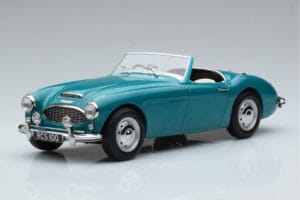
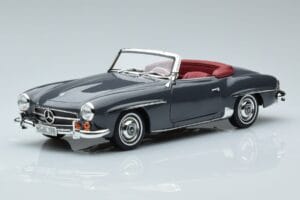
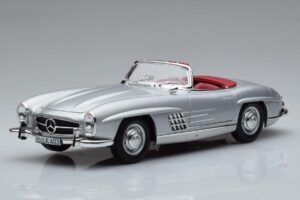
Our 1950s collection includes 3 scale replicas in diecast and resin — road cars, racing legends, and limited editions from the period. Featured marques: Austin-Healey, Mercedes.
Which car brands define the 1950s?
The 1950s produced cars from Austin-Healey, Mercedes — many now discontinued in model form and sought after by collectors. Browse by brand to find specific models from the period.
What are the most collectible 1950s car models?
The most sought-after 1950s replicas are limited-edition recreations of legendary road and race cars. Discontinued models in low production runs (under 1,000 pieces) appreciate fastest. Original packaging and certificates add value.
Which manufacturers produce 1950s model cars?
1950s car replicas are produced by Norev. Diecast brands focus on accurate road cars; resin specialists recreate rare and limited variants unavailable elsewhere.
What scales are available for 1950s models?
1950s models are available in 1:18. The 1:18 scale captures period-correct details best — chrome trim, dashboard gauges, and engine bays authentic to the era.
Why do collectors love 1950s car models?
The 1950s produced some of the most iconic cars in automotive history — and model manufacturers capture that legacy in precise detail. Limited editions of legendary road and race cars from the period are highly sought after. Period-correct details make these models time capsules of automotive design.
How are model cars shipped?
5-layer packing: original box, bubble wrap, foam inserts, reinforced carton, FRAGILE markings. All shipments tracked and insured. Damage rate under 0.1%.
Do you offer returns?
14-day returns on unused items in original packaging. Defective or damaged in transit? Free replacement — contact us with photos within 48 hours.
1950s model cars capture the decade when American optimism met European performance, turning chrome-laden boulevard cruisers and purpose-built racers into lasting icons. In scale, the 1950s is all about shape and surface—two-tone paint breaks, delicate hood ornaments, whitewall tires, and wire wheels that have to look right from across the room. Whether you’re chasing a first-generation Corvette, a fins-out Cadillac, or a Mercedes 300 SL, this era rewards collectors who like storytelling as much as shelf presence.
Collectors hunt down 1950s diecast models because the decade offers variety that still feels cohesive: early postwar carryover designs, mid-decade refinement, and the wild late-'50s styling race. You’ll see family sedans, pickup trucks, coachbuilt exotics, and racing machinery in the same era window, all united by period details modern cars don’t wear anymore—chrome bumpers, vent windows, bench seats, big steering wheels, and body lines with real depth. If you like larger display pieces, 1950s 1:18 diecast model cars make trim and interior textures pop; if you collect for breadth, 1:43 and 1:64 let you build a full timeline without needing a dedicated room.1950s Model Cars and the Design Language of the Decade
Part of the appeal of 1950s collecting is watching design go from elegant to exuberant in a single decade. Early cars still carry prewar proportions—upright greenhouses, rounded fenders, and conservative chrome—before the mid-’50s sharpen things up with lower stances, cleaner body sides, and V8 power becoming mainstream. By the end of the decade, Detroit is chasing the jet-age look with towering tailfins, wraparound windshields, and enough brightwork to catch light from across the room. In miniature, those surfaces are unforgiving: a great model makes the lines look crisp, while a mediocre one can feel toy-like if the chrome is too thick or the stance is off.
American icons are a natural gateway into the era, especially for collectors who grew up on Route 66 stories and “garage find” nostalgia. Think tri-five Chevrolets, early Corvettes, Thunderbirds, and the big, confident Cadillacs that defined late-'50s luxury. The best replicas nail the details that make these cars instantly recognizable: thin roof pillars, correct two-tone separation, and period wheel and tire combos—wide whitewalls earlier in the decade, thinner whites as the styling race heated up. Even the interior matters more than you’d expect in this era; bench seats, column shifters, and bright dashboard trim are part of the whole 1950s vibe, not an afterthought.
European and British classics bring a different kind of appeal: lighter proportions, purposeful sports-car shapes, and the sense that racing and road design were closely linked. A Porsche 356, Jaguar XK, or Mercedes-Benz 300 SL looks clean and mechanical compared to the chrome showpieces coming out of Detroit, and that contrast plays beautifully on a shelf. Collectors often pair these with Italian grand tourers—Ferrari and Maserati shapes that feel like rolling sculpture—because the 1950s is where the “GT” idea really takes off. If your taste leans toward understated, this side of the decade offers elegance without needing fins to make a statement.
When you’re comparing 1950s classic car replicas, look beyond the headline subject and focus on the hard-to-fake craftsmanship cues. Chrome trim should be sharp and consistent, not wavy or overdone, and the paint should have depth without drowning character lines. Wire wheels and knockoffs are a big tell: in 1:18 they should look delicate rather than chunky, and in 1:43 they should still read as wire rather than a generic disc. Small details like separate hood ornaments, accurate scripts, and the right ride height matter more in this decade than in many modern supercar replicas, because the real cars were defined by those finishing touches.Racing Stories That Define the 1950s
The 1950s motorsport scene is a collector’s playground because it’s packed with visual identity—bold number circles, national racing colors, and liveries that were painted with purpose rather than designed by committee. Endurance racing at Le Mans and across Europe produced legends like the Jaguar D-Type and the Mercedes 300 SLR, while Italian road races such as the Mille Miglia added danger, romance, and a sense of place that still shows up in the way collectors display these models. In scale form, this era looks especially authentic when the model captures period-correct details: narrow tires, exposed spare wheels, leather straps, mesh grilles, and cockpit layouts that feel mechanical and simple.
Grand Prix racing in the 1950s delivers a different visual language—open wheels, minimal bodywork, and engineering you can practically read at a glance. Cars like the Maserati 250F and Ferrari’s early championship machines represent an era when drivers were heroes and the cars were brutally honest. For collectors, these are ideal “conversation pieces” because they don’t need a modern backstory; the design itself tells you everything about the period. Many collectors like to group 1950s racers by theme—Italian vs British vs German engineering, or a timeline of how aerodynamics and chassis design evolved—because the decade shows rapid progress without losing the handmade vibe.
On the American side, the decade is full of performance culture that’s become part of collector DNA: early NASCAR stock cars, the rise of drag racing, and the Bonneville salt-flats pursuit of speed. Hudson Hornets, big V8 sedans, and hot rods capture a uniquely American idea of racing—more raw and relatable than European endurance, yet equally historic. If you build dioramas, the 1950s is prime territory: a two-lane highway scene, a drive-in parking lot, or a dusty oval-track paddock instantly reads as “mid-century” with just a few period props and the right mix of cars.Scale and Material Choices for 1950s Replicas
In 1:18 scale, 1950s cars become true display objects. The extra size makes chrome trim believable, lets two-tone paint breaks look clean instead of cramped, and gives interiors enough space to show the period character—bench seats, wide dashboards, and steering wheels that look like ship helms. This is also the scale where opening features can be meaningful: hoods that reveal straight-sixes or early V8 layouts, trunks with full-size spares, and doors that show the shape of mid-century door cards and window frames. For collectors who want a handful of “hero cars,” 1:18 is often the sweet spot for the decade.
1:43 scale is where the 1950s becomes a true era collection rather than a few favorites. You can build a shelf that tells a story—early-decade conservatism to late-decade excess—without the space commitment of larger models. It’s also a strong scale for mixing road and race in the same display, because a Le Mans winner doesn’t dwarf a road-going sports car the way it can in larger formats. Many collectors like 1:43 for coachbuilt European subjects and racing cars, since the scale is big enough for accurate proportions while staying practical for multi-car timelines.
1:64 scale is perfect if you collect with a “curator mindset” but live with real-world space limits. It’s also the scale that plays best with dioramas and customization communities, especially for American 1950s themes like hot rods, customs, and roadside scenes. The tradeoff is that the decade’s signature details—scripts, grille textures, thin chrome surrounds—can get simplified, so it helps to be selective. The best small-scale pieces still capture stance and silhouette, which is arguably the most important thing for 1950s cars; if the proportions are right, your eye fills in the rest when the display is cohesive.
Material choice matters in this era because the cars themselves were all about surface finish. Diecast often delivers satisfying weight and, in larger scales, working openings that feel great when you’re handling the model. Resin tends to win on crispness and fine trim, especially when the subject has complex curves or delicate brightwork that would be bulky in cast metal. Neither is automatically “better”; the right choice depends on whether you prioritize interaction and mechanical features, or the cleanest possible exterior lines. For 1950s subjects with lots of chrome and intricate grilles, a well-executed resin piece can look remarkably realistic under display lighting.Model Makers and Strategies for Building a 1950s Collection
The 1950s category spans multiple quality tiers, and knowing the landscape helps you spend smart. In smaller scales, mass-market lines can be a fun way to build themes quickly, while mid-tier brands often bring sharper paint and better proportions for the same subjects. In 1:18 and 1:43, you’ll see everything from accessible classics to premium “craftsmanship-first” releases where the model is as much about miniature engineering as it is about the car itself. Racing-focused makers are especially valuable for this decade because the 1950s had so many historically significant winners and one-off variants that collectors want represented accurately.
If you’re comparing manufacturers, use the decade’s quirks as your checklist. The best 1950s models get the stance right—many real cars sat lower than people remember—and they avoid cartoonish chrome thickness. Scripts should be clean, grille textures should look layered rather than flat, and two-tone paint should have a crisp edge instead of a fuzzy line. On convertibles, look for believable top seams and windshield frame thickness, and on coupes, pay attention to window shapes and roof pillars because small errors jump out on mid-century designs. Those details are the difference between a model that feels like a period artifact and one that just looks like a generic old car.
Collection-building is where the 1950s really shines, because you can assemble displays with a strong “time and place” identity. Some collectors go all-in on late-'50s tailfin excess, stacking up Cadillacs, Chevys, and Chryslers like a neon-lit boulevard. Others focus on sports-car evolution—356 to 300 SL to the early Ferrari and Maserati shapes that set the template for later exotics. Racing collectors often build grids: a Le Mans shelf, an early F1 lineup, or an Americana theme that mixes stock cars, hot rods, and street machines. However you do it, the decade rewards coherence; even a small group looks intentional when the cars share the same mid-century design language.
As you browse the models in this era, think like a curator: pick a scale that fits your space, then decide whether you want a “museum row” of a few high-impact pieces or a timeline that covers the full decade. The best 1950s classic car replicas aren’t just pretty—they carry atmosphere, from chrome reflections to period wheel choices to the simple honesty of early racing machines. Explore the selection and build a display that feels like the decade itself: optimistic, mechanical, and unapologetically stylish.